 Long ago, about 40 years ago, hubby and I became Peace Corps Volunteers to Ethiopia. Our two years were completed despite a general national unrest and eventual revolution but we did manage to see much, to absorb much, and to tuck away memories that simply do not fade away. I will claim today that time has not greatly undermined my memories. It has perhaps softened them, muted some of the uglier corners and removed much of the unimportant trivia that makes up the day to day even in an exotic place, but just the name "Ethiopia" resonates in my heart and mind, and I find myself thinking and planning a return somehow. My thoughts are jogged thanks in part to being in touch with a Peace Corps Volunteer who has just finished serving two years in the community in which we worked. I have a cousin who does photo tours in the Far East and he asked a bit about Ethiopia as a place to plan tours, so my juices got flowing. That, and we are attending the Returned Peace Corps Volunteer reunion in Boston this week. So my brain is about 75% in the Horn of Africa today, for better or worse. My cousin asked about an Ethiopia church celebration called Meskel, which is likely unique to the Ethiopian tradition. This holiday, more like a Holy Day, celebrates the finding of the True Cross by Queen Helena (Eleni). To the best of my knowledge, Meskel is traditionally celebrated in September, at the end of the rainy season, when the meskel flowers, ie. yellow daisies are blooming. The day celebrates the finding of the cross by Queen Helena (Eleni) who was guided by the smoke of her incense to the spot. Now, Queen Helena was the mother of the Emperor Constantine, so this is not some folkloric fable from a fanciful imagination. Queen Helena also reportedly found the tunic that the soldiers gambled for at Jesus' crucifixion. This treasure is housed in Trier, Germany, where you also find extensive wine cellars that date from early Roman times, Roman baths and other relics of times we understand little of. I do not think Helena ever visited Ethiopia, but they love her for her deeds. In Ethiopia, during Meskel, large bonfires are burned and there is huge celebration with drums and lyres, and lots ecclesiastical parading and incense. According to tradition, the real event occurred in the Spring, March or April, but was moved to September. I guess the weather is better at that time of the year.
 That said, Ethiopia is, in my mind, one of the truly fabulous and unique countries of the African Continent and, perhaps, one of the most original and true to its ancient history, in the world. I know I have not been there in 40 years (ye gads) but its rugged isolated location has protected much of the country from the usual invasion of western capital and influence. The church has always been powerful and is rooted in its 4th century origins. The Ethiopian Jews were pretty much taken to Israel in the 1986-1994 period but the Ethiopian Orthodox church maintains many of the same taboos and traditions of the early Hebrew influences... no pork or shellfish, the churches have the Holiest of Holies at their centers, the Tabot, a replica of the Ark of the Covenant, is paraded about on holy days with drums, lyre-like instruments, and lots of chanting, incense and feasting. I attended a regular Sunday service in Los Angeles that started at 6 am (everyone fasting) and lasted until 10:30 when they had bible study and eventually breakfast. The service was laden with singing, drumming, dancing, praying and incense, and more of all of the above, and that was just an ordinary Sunday. The real Holy Days get a much bigger celebration.
Another piece of lore is that the original Ark of the Covenant, given by God to Moses, was taken by Menelik, the son of Solomon and the Queen of Sheba, and hidden in Ethiopia in Axum, where it is guarded by one priest and a holy man. You can go to the church but you can't go in.
 |
| St. Mary Church, where the Ark of the Covenant is kept. |
 |
| Stele...75 feet, the tallest still standing. |
Axum is the site of an ancient and powerful center of the Axumite empire, one of the then great powers of the world that included Rome, Persia, and China. There are enormous stelae there, many fallen but some standing... in many ways more mysterious and amazing than the pyramids of Egypt (IMHO).
They are certainly less visited. These are 3rd century royal tombs that are carved to look like multi-storied buildings. The meaning of the markings and glyphs on the stelae is uncertain and the technique used for erecting these huge constructions is lost in ancient history. It was in Axum that Christianity was adopted as the official religion in 340 AD. King Ezana, who adopted the faith, was at the time producing coinage from gold, and the cross was then imprinted on the coins, acknowledging of the significance of the new faith in the ancient empire.

In another part of the country are the Lalibela churches, carved into the earth, hewn of stone, commissioned by King Lalibella perhaps to create a new Jerusalem after the conquest of Jerusalem by Saladin in 1187. Some legends say Lalibela had a dream which told him to do this. Another legend says he was poisoned and on his deathbed when angels gave him instructions and sent him back to build. Either way, the carved churches of Lalibela are a miracle of the imagination and of engineering. They continue to this day to provide spiritual and material sustenance to the people of the region. There are 10 or so of them so if you don't like one, there is always another one just through the tunnel.
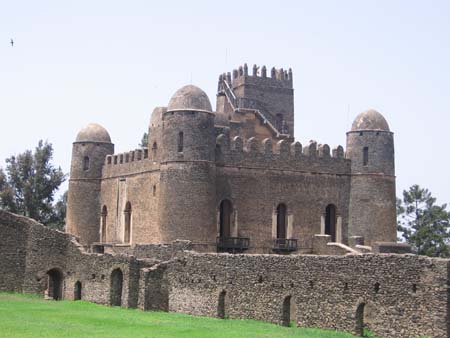 |
| Fasilades Palace- 16th century |

In the highlands and south,there are hot springs, thanks to the volcanic instability of the Rift Gorge which passes right through Ethiopia. There is a lakes district to the south of Addis Ababa, and a Nilotic region to the west called Gambella which is totally different from the rest of Ethiopia. The Southwestern piece of the country is the home of rainforests that produce some of the world's best of coffee. Kaffa province, where we lived, was the center of the coffee growing. There are animal sanctuaries, less well known than those of Kenya and Tanzania, but full of rare and special animals. Accommodations are improving, I believe, but it is a rugged country, usually best traversed by airplane unless you love twisty, dusty roads that drop to nowhere... But remember, I have not been there for a while.
Plan the trip of a lifetime to Ethiopia. Forget about la belle Provence or Phuket or Mongolia. They are forever changed with their McDs and Dunkin Donuts. Most of Ethiopia still stands shrouded in history and mystery, and offers a cuisine that is like no other. Think about taking a good look at Ethiopia, land with 13 months of sunshine. You will be glad you did.
