Saturday, November 9, 2013

My Fear


I fear little
not death nor life
not pain nor uncertainty
not turmoil nor the future
I am not sure about fear.

I see  so much and so little
emotion, for better or for worse
reaction, to life, or to my small piece of life now,
possibilities, laced with hopes and questions,     
pitfalls, those named and those unspoken.

l want goodness for us
not only goodness, but reality and truth
challenge and possibility, then
comfort and assurance in each other,
awareness and consciousness of life together and its abundance.

I know this is all we have
life now, shared existence
 this is what we share:
life now
this is what we must celebrate:
life now

I fear only these
obstinance in love, faith, forgiveness
obliteration of memory
oblivion without the redemption of love and life.


and that’s all, folks....

Monday, September 9, 2013

Life, Now


Finally, more than one full year after my retirement, I am beginning to feel like I am becoming the person I was always supposed to be.  For the curious, that would be pioneer-hunter-gatherer-survivalist.  Who would ever have predicted this?  I understand that there is often regression as part and parcel of the aging process.  Often we become less capable in skills we had once mastered, less interested in the new and exciting developments brought to us via modern business, less adventurous in the wilderness. We may even eventually return to very early childhood-like behaviors.... eating soft foods, needing reminders to zip, and even (shudder) returning to diapers and sides on the bed again. No, no... I am not yet even close to these final stages and really hope to simply pop off one day before I have to ask someone to turn me over in bed because I can no longer do that. Actually, I can think of good reasons to ask someone  to turn me over in bed but disability is not one of them. I digress.  I feel kind of reborn, if you will, into a new time, a simpler time, but one filled with lots of hard work not typically done by your average middle-age ex-teacher person.  We have lived a fairly conventional life made up of regular jobs and paychecks, kids involved in school and sports and on to college, their own marriages and lives, and plenty of grocery shopping using the family van. We now have the empty nest and I quit... I am essentially now a kept woman, as the hubby toils away still, bringing home the real bacon. Someday, he will also discover the joys of retirement, but not yet.  I would invoke the Italian phrase "dolce far niente", translated as "so sweet to do nothing"... but that is not exactly accurate either.  I ask your indulgence as I employ that old saw "we are human beings, not human doings" The "doing"  vs "being" distinction is important.  I am certainly not ready to be nothing and I am certainly not doing nothing.  I simply do not know the Italian words  for "so sweet to be what I want to be when I want to do whatever or be some way or another".

Our habitat of choice is fairly isolated, not far from people but home is not a peopled place. We are connected to the world via satellite and internet, telephone and automobile. Now, I find days go by without using the car. I stick around here. I have not given up the electronic connections but can actually imagine not having the television and internet.  We have been without both of those for most of early life and many of our adult years. The TV would not be missed. The computer seems to have replaced human contact with email and facebook contact, though it is useful for making party invitations. It has supplanted cookbooks, newspapers, gossip magazines, real letters and cards, phone conversations, books and travel agents. I hear they are working on replacing teachers in public schools with internet learning, and we know it is used for higher education, if you call an online program an education. Here again rises my outraged atavistic perspective, that real learning comes from relationships and common experiences, not from a list of facts and reading recommendations. But I suspect I will lose this battle.  Not the first nor the last. How much of this should I keep to myself? I am sure I will eventually be proven correct...


I am still evolving and the world is evolving. We are just following different spirals, sometimes almost touching but generally on our own inevitable tracks.  I wonder if my pioneer-hunter-gatherer-survivalist persona will become more apparent or necessary with time. Today my big decisions are should I make apple sauce or apple butter out of the 20 pounds of drops I picked up today?  Or maybe just dehydrate them until a better idea comes along? The sauerkraut is fermented and canned... should I start a new batch or make coleslaw and cabbage soup? Should I gather the cabbage in the garden all in before the woodchuck finds it? Will this or that field be better for a couple of sheep?  I sometimes have to work to keep my thoughts from considering post-apocalyptic scenarios, where the survivalist piece might be useful. Not World War Z but there are plenty of weirdos out there and lots of heavy weaponry. I mostly like where I find myself these days, working on things that seem almost ready to disappear from modern knowledge and experience. Vermont is a great place to be this way.. a place where good husbandry, good food, simple pleasures, caring communities and a vibrant history and culture are valued and practiced.  Maybe I just have to evolve a bit more into this life as it is, now that I have shed the shackles of the workaday world. Here, the only deadlines are the ones I set for myself...


Tuesday, September 3, 2013

Time Travelling


Here is another piece for our writing group...


Time Travelling to 1935.

I have taken myself back to 1935, to Iron Mountain in the Upper Peninsula of Michigan, where my father’s parents live on a small farm at Pine Creek. It is summertime, which is the best time to travel in the northern regions, a warm and fruitful time.  1935 tells me the Great Depression is upon us but it is not raging in the farming communities in this place. I want to meet and visit with my grandmother, whom I never met. I am told I am very much like her. I have a picture in my house of the family, taken probably about 1925  or so. My dad, born in 1919, is about 6 in the photo.  The youngest child, my uncle Walter, is a baby, no more than a year old, as he would be in 1925.  Grandma is a solid, sober looking woman, 45 years old, mother of 8 living children, all born within the span of 12 years. My dad looks like her, I look like my dad, so the physical evidence is there.  She immigrated from Swedish speaking Finland in 1908. She arrived with a Russian passport, thanks to geopolitical realities, but has always been identified as Swedish, so that is what we say now.

Before 1933, the family lived in town. Grandpa was a shoemaker and had a shop that the US government took to build a post office in Iron Mountain. Grandma had grown up on a farm, the child of crofters on a large place, and she wanted to go back to farming. The other side of the coin is that she insisted that the family move out of town to remove Grandpa from the earthly temptations of drinking and womanizing, but there is no proof of the second sin. They were married 11/11/11, and Grandma is quoted as saying, while 11/11 might be remembered as Armistice Day, for her that was when the war began. Though not prosperous, they lived a self-sufficient rural life on the farm until Grandma died in 1945.

We are in Grandma’s kitchen. It is mid morning. Everyday is baking day, she says, as bread is rising and pies are in the oven. I help by chopping dried apples for coffee cake. It is hot work in July, as the stove needs wood and the kitchen heats up. Kids are doing chores, off with mates, or making plans to attend dances in town. She has already tended the garden and ripe tomatoes and cukes sit in a basket, ready to round out the lunch of sandwiches, pickled beets, and milk. Coffee is on the stove and a fresh pot will be brewed when her neighbor ladies come for “fika”, the afternoon coffee break with cake and smokes in the kitchen. Grandma tells me that they will make plans for their annual weaving days. She will go to her sister Lisa’s house, taking with her the worn clothes and rags collected in the past year, and they will have a little vacation, weaving rag rugs. She says the kids get a kick out of trying to identify their old clothes in the rugs that are scattered through the house. The house is old but has indoor plumbing, a toilet in a closet and a tub. There is a furnace with one vent upstairs in the hallway between the bedrooms. There, the kids leap out of bed and dress over the vent in winter. Grandma tells me that she is glad she moved to America. In Finland, life was hard, work was endless and there was little expectation of better. She only went to 4 years of school and her father and six siblings all moved to America. Only her mother stayed there. Grandma said her father left Finland for America in 1884, when she was just 4, and they never heard from him again.  She tries to explain some of the relations but they are pieces of a complex and incomplete puzzle to me. They all have the same name but it is more of a place name than a family name. She shares some family stories.. both sides, grandpa’s and hers, have their share of members arrested for drunkenness or breaking the Sabbath, births out of wedlock, even thievery, but also the stories of immigration and starting a life in a new place.  Interesting to me but Grandma has apparently moved on from her past.. there is no time for sentimentality with a large family on a farm during the depression. So the stories are brief, the sun is warm, lunch is ready,  and her friends will arrive for coffee. Corn from the fields has been picked for supper.  There is a lull as lunchtime approaches. I must go. She will die in 1945 and I will be born in 1948, so we never meet. I like to think that I have her country soul, transferred to me via some kind of genetic/cosmic magic. I do have her face, her solid body, and a firstborn child at age 32. I am hoping I have more than the 65 years she was allotted.


Sunday, July 21, 2013

Speed Writing

Our little writing group meets every couple of weeks. Our goals vary, some looking for practice or advice, some for fun. We generate an idea, a sentence, or a topic to write about and generally allow ten minutes to complete the exercise. Now, ten minutes is not much time to put coherent thoughts together but that is about all our fingers and hands can handle, given the longhand requirement.  It is too much time sometimes, given the topic and stuttering mental flow. Topics range and outcome vary wildly. That is the fun part.  I share with you now my exercise, given ten minutes and the topic "In a State of Disarray" (my caps). Enjoy.  And feel free to comment. We all want clarity....

In a state of disarray
I take my life, day by day.
The house can wait, the laundry, too.
I have less important things to do.
Some call it ADHD, age related
I call it mainly discombobulated.
A random thought flies by my head.
I reach to catch it with some dread.
Because I know that when I stop
another thing in my head will pop.
What's more important, this or that?
I think I  need to brush the cat.
No, sweep the floor but not till later
because I know it won't get better.
Garden to clean or was it my closet?
I'm usually quite sure but now I've lost it.
Do I have an appointment- I'll check my book,
Or maybe the other one is where to look.
My mate's not much better; we both kind of stew
He says it is my job- I say, but you knew.
So on we go til we have a goal
And then we can sight on the  not distant pole.
The best way to accomplish the tedious tasks
is to both start our work and to not finish last.
Cause whoever is done first is likely the winner
Even though that one has to cook dinner.
It's a summer event, this lack of a focus,
A change in the season, it just seems to poke us,
On to the deadlines and duties of work
At least he is working though I am still in the murk
The housework, the church work, the yard work, the chickens...
I'd rather be singing or reading some Dickens.


That's all, Folks... ten minutes of scribbling about a state of disarray.  Give it your best shot.


Monday, June 24, 2013

Lost in Time.


photo Long ago, about 40 years ago, hubby and I became Peace Corps Volunteers to Ethiopia.  Our two years were completed despite a general national unrest and eventual revolution but we did manage to see much, to absorb much, and to tuck away memories that simply do not fade away. I will claim today that time has not greatly undermined my memories. It has perhaps softened them, muted some of the uglier corners and removed much of the unimportant trivia that makes up the day to day even in an exotic place, but just the name "Ethiopia" resonates in my heart and mind, and I find myself thinking and planning a return somehow. My thoughts are jogged thanks in part to being in touch with a Peace Corps Volunteer who has just finished serving two years in the community in which we worked.  I have a cousin who does photo tours in the Far East and he asked a bit about Ethiopia as a place to plan tours, so my juices got flowing. That, and we are attending the Returned Peace Corps Volunteer reunion in Boston this week.  So my brain is about 75% in the Horn of Africa today, for better or worse. My cousin asked about an Ethiopia church celebration called Meskel, which is likely unique to the Ethiopian tradition. This holiday, more like a Holy Day, celebrates the finding of the True Cross by Queen Helena (Eleni).  To the best of my knowledge, Meskel is traditionally celebrated in September, at the end of the rainy season, when the meskel flowers, ie. yellow daisies are blooming.  The day celebrates the finding of the cross by Queen Helena (Eleni) who was guided by the smoke of her incense to the spot.  Now, Queen Helena was the mother of the Emperor Constantine, so this is not some folkloric fable from a fanciful imagination.  Queen Helena also reportedly found the tunic that the soldiers gambled for at Jesus' crucifixion.  This treasure is housed in Trier, Germany, where you also find extensive wine cellars that date from early Roman times, Roman baths and other relics of  times we understand little of.  I do not think Helena ever visited Ethiopia, but they love her for her deeds. In Ethiopia, during Meskel, large bonfires are burned and there is huge celebration with drums and lyres, and lots ecclesiastical parading and incense. According to tradition, the real event occurred in the Spring, March or April, but was moved to September. I guess the weather is better at that time of the year. 

That said, Ethiopia is, in my mind, one of the truly fabulous and unique countries of the African Continent and, perhaps, one of the most original and true to its ancient history, in the world. I know I have not been there in 40 years (ye gads) but its rugged isolated location has protected much of the country from the usual invasion of western capital and influence. The church has always been powerful and is rooted in its 4th century origins. The Ethiopian Jews were pretty much taken to Israel in the 1986-1994 period but the Ethiopian Orthodox church maintains many of the same taboos and traditions of the early Hebrew influences... no pork or shellfish, the churches have the Holiest of Holies at their centers, the Tabot, a replica of the Ark of the Covenant, is paraded about on holy days with drums, lyre-like instruments, and lots of chanting, incense and feasting.  I attended a regular Sunday service in Los Angeles that started at 6 am (everyone fasting) and lasted until 10:30 when they had bible study and eventually breakfast. The service was laden with singing, drumming, dancing, praying and incense, and more of all of the above, and that was just an ordinary Sunday. The real Holy Days get a much bigger celebration.

Another piece of  lore is that the original Ark of the Covenant, given by God to Moses, was taken by Menelik, the son of Solomon and the Queen of Sheba, and hidden in Ethiopia in Axum, where it is guarded by one priest and a holy man. You can go to the church but you can't go in.
Saint Mary Church - Ark of the Covenant Sanctuary
St. Mary Church, where the Ark of the Covenant is kept.
                                              Stele...75 feet, the tallest still standing.
 Axum is the site of an ancient and powerful center of the Axumite empire, one of the then great powers of the world that included Rome, Persia, and China. There are enormous stelae there, many fallen but some standing... in many ways more mysterious and amazing than the pyramids of Egypt (IMHO). 
They are certainly less visited.  These are 3rd century royal tombs that are carved to look like multi-storied buildings. The meaning of the markings and glyphs on the stelae is uncertain and the technique used for erecting these huge constructions is lost in ancient history. It was in Axum that Christianity was adopted as the official religion in 340 AD. King Ezana, who adopted the faith, was at the time producing coinage from gold, and the cross was then imprinted on the coins, acknowledging of the significance of the new faith in the ancient empire.


In another part of the country are the Lalibela churches, carved into the earth, hewn of stone, commissioned by King Lalibella perhaps to create a new Jerusalem after the conquest of Jerusalem by Saladin in 1187. Some legends say Lalibela had a dream which told him to do this. Another legend says he was poisoned and on his deathbed when angels gave him instructions and sent him back to build. Either way, the carved churches of Lalibela are a miracle of the imagination and of engineering. They continue to this day to provide spiritual and material sustenance to the people of the region. There are 10 or so of them so if you don't like one, there is always another one just through the tunnel.

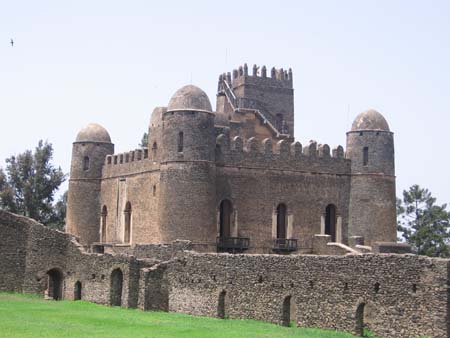
Fasiledes Casthe, Gondar
Fasilades Palace- 16th century
Another amazing historic site is Gondar, the 17th century capital of the Ethiopian highlands. It is at 7500 feet above sea level.The impetus for locating the capital here is uncertain. Again, angels may have been involved, or it might have been considered to be safer from the raids of the militant Ahmed Gragn, who was pillaging the country here and there. In the architecture of the extant buildings, you will see the influences of Arabia and North Africa, a testament to the extent of the Ethiopian trading empire


The Blue Nile, accessible on foot to most, has its source near Gondar. If you do not want to walk, you can hire a horsedrawn taxi. The Blue Nile provides about 59% of the water that flows into the Nile Delta. The water ebbs and flows with the seasons and the Ethiopian name, Tisissat, means water that smokes. And things are smoking a bit now that Ethiopia is considering diverting the water for electricity production. See it while you can.

In the highlands and south,there are hot springs, thanks to the volcanic instability of the Rift Gorge which passes right through Ethiopia. There is a lakes district to the south of Addis Ababa, and a Nilotic region to the west called Gambella which is totally different from the rest of Ethiopia. The Southwestern piece of the country is the home of rainforests that produce some of the world's best of coffee. Kaffa province, where we lived, was the center of the coffee growing.  There are animal sanctuaries, less well known than those of Kenya and Tanzania, but full of rare and special animals. Accommodations are improving, I believe, but it is a rugged country, usually best traversed by airplane unless you love twisty, dusty roads that drop to nowhere...  But remember, I have not been there for a while.

Plan the trip of a lifetime to Ethiopia. Forget about la belle Provence or Phuket or Mongolia. They are forever changed with their McDs and Dunkin Donuts. Most of Ethiopia still stands shrouded in history and mystery, and offers a cuisine that is like no other. Think about taking a good look at Ethiopia, land with 13 months of sunshine. You will be glad you did.